Metaverse in Education: 5 Real Uses Beyond the Hype
The metaverse in education means shared, persistent virtual spaces where students and teachers meet, learn and build together as avatars. Think of a virtual campus, a 3D science museum or a digital lab that the whole class can enter at the same time from different places.
A few years ago, the word “metaverse” was everywhere. Big promises were made, and many of them faded. So what is real today? In this article we cut through the noise. We explain what actually works, give you a simple test to judge any platform, and show how schools and colleges can start small.
What the Metaverse Really Means for Learning
The metaverse is not one product or one company. It is a broad idea: connected 3D spaces that people enter with a VR headset, a computer or even a phone. For education, three features matter more than any brand name.
- Shared: many learners are in the same space at the same time
- Persistent: the space stays as you left it, so projects can grow over weeks
- Interactive: learners can build, move and change things, not just watch
If a platform lacks these features, it is really just a 3D video or a game, not the metaverse in education.
The 3P Test: How to Judge Any Metaverse Platform
Before you sign up for any platform, test it against three Ps. This simple filter saves a lot of money.
- Presence: Do students genuinely feel they are in a place together? Can they see where others are looking and pointing?
- Purpose: Is there a clear learning task, or is it just a pretty space to walk around?
- Participation: Do students create and change things, or only consume content?
A platform that scores well on all three is worth a pilot. One that only looks impressive will lose students’ interest within weeks.

5 Real Uses of the Metaverse in Education
1. Virtual field trips with the whole class
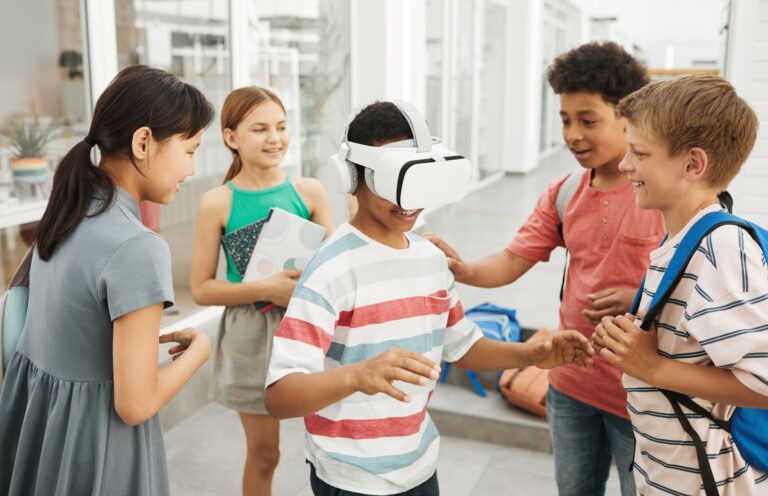
Instead of one student exploring alone, the whole class walks through a virtual rainforest, a historical city or the inside of a power plant together. The teacher guides the group, stops at key points and asks questions. Compared with a video, students remember far more because they were “there”.
2. Shared science and engineering labs
Students from different campuses can work on the same virtual experiment. One group sets up the apparatus, another records results, and a third analyses them. This mirrors how real research teams work across cities.
3. Collaborative design studios
Architecture and engineering students can build 3D models together inside a shared space. They walk through their own building before it exists, spot problems and fix them as a team.
4. Virtual events, exhibitions and open days
Colleges can host project expos, guest lectures and admission open days in a virtual campus. Parents and students from far away can attend without travelling. Moreover, project models stay on display long after the event ends.
5. Language and soft skills practice
Students can practise a new language or a job interview with classmates or AI characters in realistic settings, such as a railway station or an office. Because they are avatars, many shy students speak more freely.
What Did Not Work, and Why
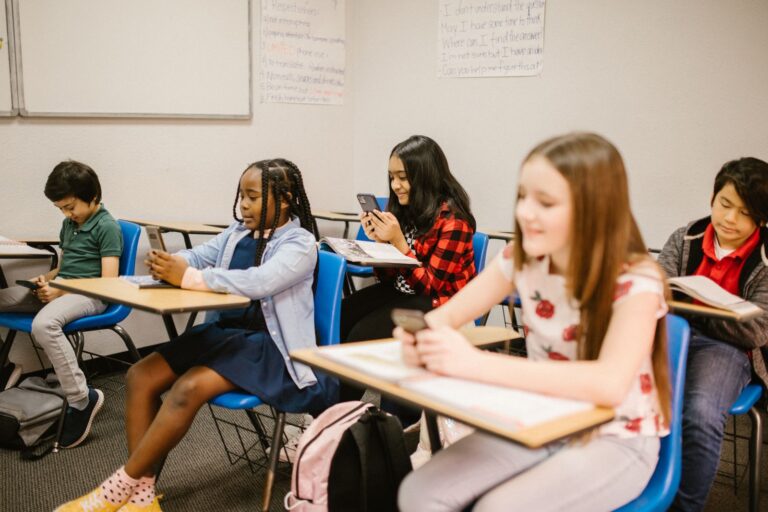
It is worth being honest about the failures, because they teach us a lot. Many early metaverse in education projects failed for three reasons. First, they copied the real classroom too closely, with avatars sitting in rows watching a slide. That adds nothing. Second, they needed expensive hardware that schools could not afford. Third, there was no clear learning goal, so novelty wore off quickly.
The lesson is clear. Use the metaverse only for things a normal classroom cannot do, such as shared 3D exploration, remote collaboration and safe simulation.
Safety, Privacy and Wellbeing
When students meet in shared online spaces, safety comes first. Choose platforms that let teachers control who can enter, mute or remove users, and record sessions. Keep student data on platforms that follow Indian data protection rules. Limit session length, especially for younger learners. Organisations such as UNESCO stress that digital learning must stay safe, inclusive and focused on learning, not screen time.
How Schools and Colleges Can Start Small
You do not need a full virtual campus on day one. Instead, follow a simple path:
- Run one virtual field trip per term for one class
- Host one project expo in a virtual hall
- Pick one subject for a shared virtual lab pilot
- Collect student feedback and learning results after each activity
- Expand only what clearly works
Access also matters. Pick platforms that run on laptops and phones as well as headsets, so no student is left out.
Here is a simple example. A college runs its annual project expo in a virtual hall for the first time. Each final-year team gets a booth with its 3D model, a short video and a live chat slot. Parents in other towns visit in the evening, and recruiters drop in between meetings. The physical expo still happens, but the virtual hall stays open for a month. That single, low-risk pilot shows management exactly what the metaverse in education can add, and what it cannot.
The Metaverse, XR and AI Together
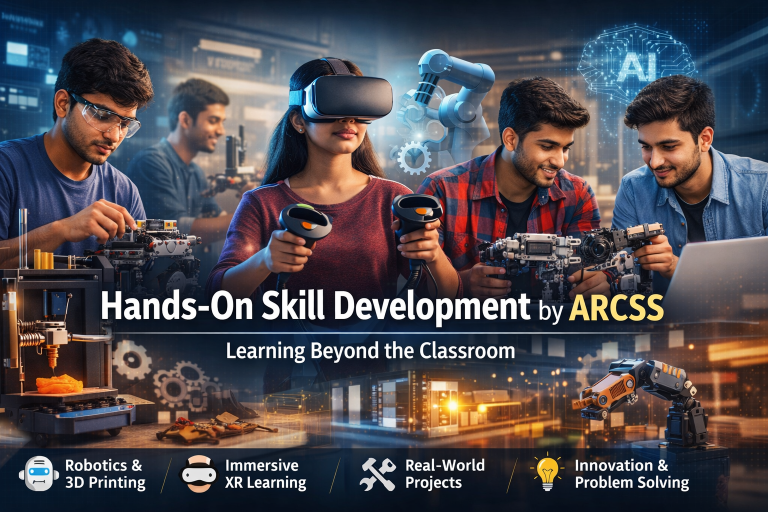
The metaverse in education does not stand alone. It is built on extended reality, and AI is making it smarter, with virtual tutors and characters that respond naturally. To understand the building blocks, read our guide on how XR learning works and our article on AI and extended reality in education. If you plan to run metaverse sessions on campus, our step-by-step guide to setting up an XR lab for colleges will help.
Frequently Asked Questions
Do students need VR headsets for the metaverse?
No. Most education platforms work on laptops and phones too. Headsets give a deeper experience but are not required.
Is the metaverse in education just a trend?
The hype has faded, but the useful parts remain: shared 3D spaces, remote collaboration and safe simulation. These are growing steadily.
What age is suitable?
Middle school and above, with teacher supervision. For younger children, short guided sessions on a screen are better.
Conclusion
The metaverse in education is not a magic replacement for school. However, when it passes the 3P test of presence, purpose and participation, it can do things no classroom can. Start with one field trip or one expo, measure the results, and grow from there. To explore immersive and shared virtual learning for your institution, visit our Immersive Learning page or contact the ARCS team.