
How AI and Extended Reality Are Transforming Education in 2026
AI and extended reality are each powerful on their own. Together, they are changing education in a way neither could manage alone. Extended reality, or XR, gives students a place to learn by seeing and doing. Artificial intelligence gives that place a brain that can listen, adapt and explain.
A simple way to remember it: XR is the body, AI is the brain. XR builds the lab, the planet or the patient. AI decides what happens next based on what the student does. In this article we look at five real changes this pairing brings in 2026, and at a new kind of risk that few people are talking about.
Why AI and Extended Reality Work Better Together
Before AI, most XR lessons were fixed. Every student saw the same scene, heard the same narration and followed the same steps. A fast learner got bored. A struggling learner got lost. Nobody in the headset could ask a question.
AI fixes these gaps. It can notice what a student is looking at, how long they hesitate and which mistakes they repeat. Then it can change the lesson, give a hint or answer a spoken question. This is close to the old dream of the intelligent tutoring system, but placed inside a 3D world instead of a text box.
5 Ways AI and Extended Reality Are Transforming Education
1. Lessons that adapt in real time
If a student keeps connecting a circuit wrongly, the AI slows down, highlights the correct terminal and offers a simpler version of the task. If a student finishes early, it adds a challenge. Every learner gets a lesson that fits their level.
2. Virtual characters you can talk to
Medical trainees can question a virtual patient about symptoms. History students can interview a character from the freedom movement. Language learners can practice ordering food in a virtual shop. AI lets these characters answer naturally instead of following a fixed script.
3. Scenes created in minutes
Building XR content used to need a team of 3D artists. With generative AI, a teacher can describe a scene, such as “a river delta with rice fields and a flood warning”, and get a working draft quickly. The teacher still checks and edits it, but the barrier to creating content is much lower.
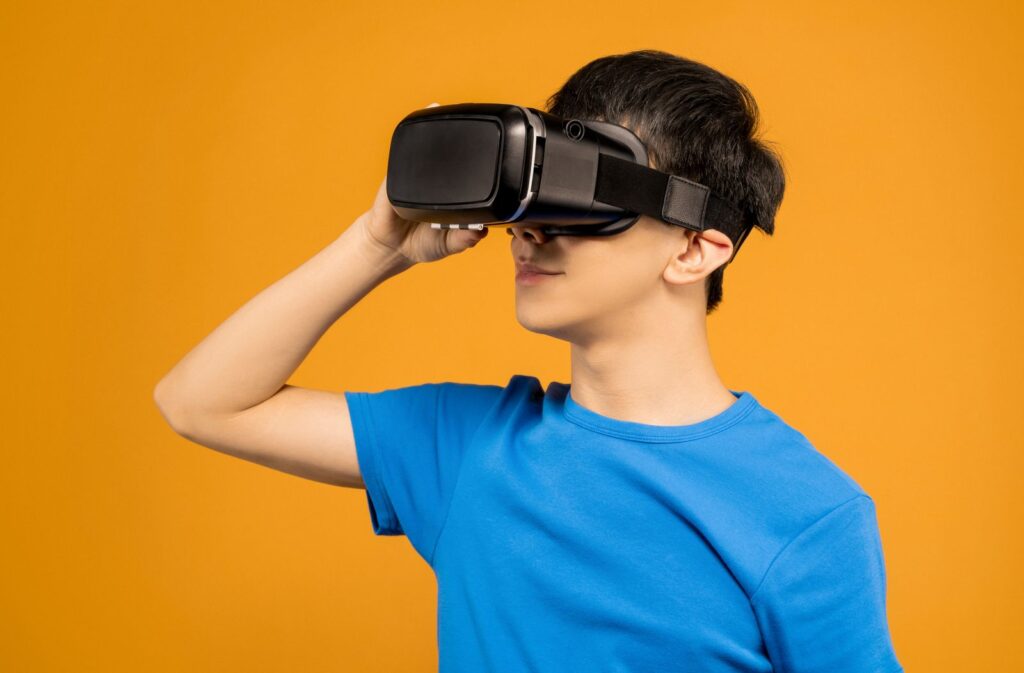
4. Feedback on hands, not just answers
Hand tracking plus AI means the system can judge how a student performs a task: the grip on a tool, the order of steps, the steadiness of a movement. This matters for vocational training, nursing and lab skills, where how you do something counts as much as what you know.
5. Learning in your own language
For India, this may be the biggest change of all. AI voice tools can narrate and answer questions in Tamil, Hindi, Telugu, Bengali and many other languages. A student in a rural school can explore the same virtual lab as a student in a city, with explanations in their mother tongue. AI and extended reality together can make high quality practical learning far more equal.
What a Lesson With AI and Extended Reality Looks Like
Picture a Class 11 student learning about the human heart. She puts on a headset and stands beside a large, beating heart. She asks out loud, in Tamil, why the left side of the heart has thicker walls. The AI answers in simple Tamil and highlights the left ventricle. She then tries to trace the path of blood but gets the order of the valves wrong. The system pauses, shows the correct path slowly and asks her to try again. On the second try she gets it right, and the AI suggests a harder challenge: what happens if one valve leaks?
After ten minutes she takes off the headset and explains the blood path to her partner. The teacher listens and corrects one small detail. That is AI and extended reality working as intended: personal, patient and followed by real human discussion.
A New Risk: Believable Mistakes
Here is a point most articles miss. AI tools sometimes produce confident but wrong answers. In a text chat, a careful student may doubt them. Inside an immersive 3D world, the same wrong answer feels much more real. A wrongly labelled organ or an incorrect chemical reaction, shown in full 3D with a calm voice, can be very convincing.
We call this the believability risk. The more immersive the setting, the more carefully the content must be checked. Schools using AI and extended reality should follow three simple rules.
- Teacher review: any AI generated scene is checked by a subject teacher before students use it.
- Visible sources: the system should show where facts come from when asked.
- Doubt is a skill: students are taught to question the virtual world, not just accept it.
Other Challenges to Plan For
- Privacy: XR devices collect eye, hand and voice data. Schools need clear policies on what is stored and for how long.
- Screen time: keep immersive sessions short and balanced with group work.
- Cost and access: shared device rotations and browser based XR help keep costs down.
- Teacher training: teachers need time to learn how to guide AI powered sessions.

What Stays the Same
Even with AI and extended reality, good teaching principles do not change. Students still learn best when they have a clear question, try something, get feedback and then explain it in their own words. AI can give feedback faster and XR can make the experience richer, but the teacher still sets the purpose and leads the reflection. We describe this approach on our Pedagogy page.
How Schools Can Start in 2026
- Choose one subject where students need both practice and explanation, such as lab science or nursing skills.
- Pilot one AI enabled XR lesson with a small group.
- Have teachers review all content for accuracy.
- Collect feedback on learning, comfort and language support.
- Scale up only what clearly helped.
New to XR? Start with what extended reality in education is. Curious about STEM subjects? Read how extended reality is transforming STEM education.
Frequently Asked Questions
How do AI and extended reality help students?
XR lets students see and practice, while AI adapts the lesson, answers questions and gives feedback, so each student learns at the right pace.
Will AI and extended reality replace teachers?
No. They take over repetitive explaining and checking, which frees teachers to guide thinking and discussion.
Is it safe for children?
It can be, with short sessions, teacher reviewed content and clear rules on data privacy.
Conclusion
AI and extended reality are transforming education by giving virtual worlds a brain that listens and adapts. The gains are real: personal pacing, talking characters, faster content and learning in local languages. So is the believability risk. Schools that pair this technology with careful teacher review will get the best of both. Explore how ARCS builds these experiences on our Innovation and Technology page.